

Best Sleeping Position for Lower Back: Setup Guide
Last Updated: October 30, 2026
Quick Summary
The best sleeping position for lower back pain is on your side with a pillow between your knees, or on your back with a pillow under your knees. Both keep your spine neutral and take pressure off your lower back. Your best sleeping position depends on where your pain sits and how your body is built.
- A Hartford HealthCare ranking puts supported side sleeping at the top for back pain.
- A pillow under the knees should create a gentle bend of roughly 15 to 20 degrees.
- On your side, the knee pillow should run from just above the knee to the ankle.
- Change one thing at a time and give each change two or three nights.
- Bend both knees and turn your whole body as a unit when changing positions at night.
Table of Contents
- Best Sleeping Position for Lower Back Pain: The Short Answer
- How to Sleep With Lower Back Pain: A Step-by-Step Setup
- Pillow Between Knees for Back Pain: Side Sleeping Done Right
- Pillow Under Knees for Lower Back Pain: Back Sleeping Support
- Stretches for Lower Back Pain Before Bed
- Stomach Sleeping, Position Changes and Red Flags
- Frequently Asked Questions
Best Sleeping Position for Lower Back Pain: The Short Answer
The best sleeping position for lower back pain is on your side with a pillow between your knees, or on your back with a pillow under your knees.
Here's the key idea: there is no single sleeping position that works for every back. A Hartford HealthCare ranking of sleep positions puts supported side sleeping at the top for back pain, while calling back sleeping best overall.
So why do so many people still wake up aching? Because they pick a position but skip the support that makes it work.
Why Recommendations Differ
Guidance varies because backs vary. A Mayo Clinic guide to sleeping positions for back pain suggests a pillow under the knees for back sleepers and one between the legs for side sleepers.
Researchers are still studying this. A 2024 study by J. Ylinen and colleagues on sleeping position preferences looked at how people with chronic low back pain choose or avoid certain positions.
What does that mean for you? Test positions, keep what feels better by morning, and drop what doesn't.
How to Sleep With Lower Back Pain: A Step-by-Step Setup
Learning how to sleep with lower back pain comes down to support, not willpower. Set your bed up so your spine stays neutral before you lie down. Here's the order we'd follow:
Watch out: soft pillows that slide out of place by 3 a.m. undo the setup. A single firmer pillow that holds its shape usually beats three soft ones that collapse.
Setup for Different Body Types and Pain Locations
Your build and your pain point change the setup. Use this as a starting map, then adjust one variable at a time:
| Your situation | Start with | Key support | Avoid |
|---|---|---|---|
| Pain worse when bending forward | Back sleeping | Pillow under knees | Curled fetal position |
| Pain worse when arching back | Side sleeping | Pillow between knees | Stomach sleeping |
| Broad shoulders | Side sleeping | Thicker head pillow | Flat, thin pillow |
| Narrow hips | Back sleeping | Thin knee pillow | High pillow stack |
| Pain on one side only | Side sleeping, other side down | Knee pillow plus small waist roll | Lying on the sore side |
| Tall torso, short mattress | Back sleeping | Pillow under knees, head pillow that fills the neck gap | Hanging feet off the end |
How to dial in pillow height: lie on your side and have someone check your spine from behind, or use a mirror.
How to dial in knee bend: on your back, a pillow under the knees should create a gentle bend, roughly 15 to 20 degrees, not a right angle.
If you're pregnant, side sleeping is usually the most comfortable route.
Pillow Between Knees for Back Pain: Side Sleeping Done Right
A pillow between the knees for back pain works by keeping your hips, pelvis, and spine in one line. Side sleeping with support ranks as the best choice for back pain in the Hartford HealthCare position ranking, and the knee pillow is the reason.
How to set it up:
Kezmore CuddleNest | Sleep Comfortably, Feel Supported, Wake Up Refreshed. →
- Lie on your side with your knees slightly bent.
- Slide a firm pillow between your knees, from knee to ankle.
- Keep your head pillow thick enough to fill the gap between your neck and the mattress.
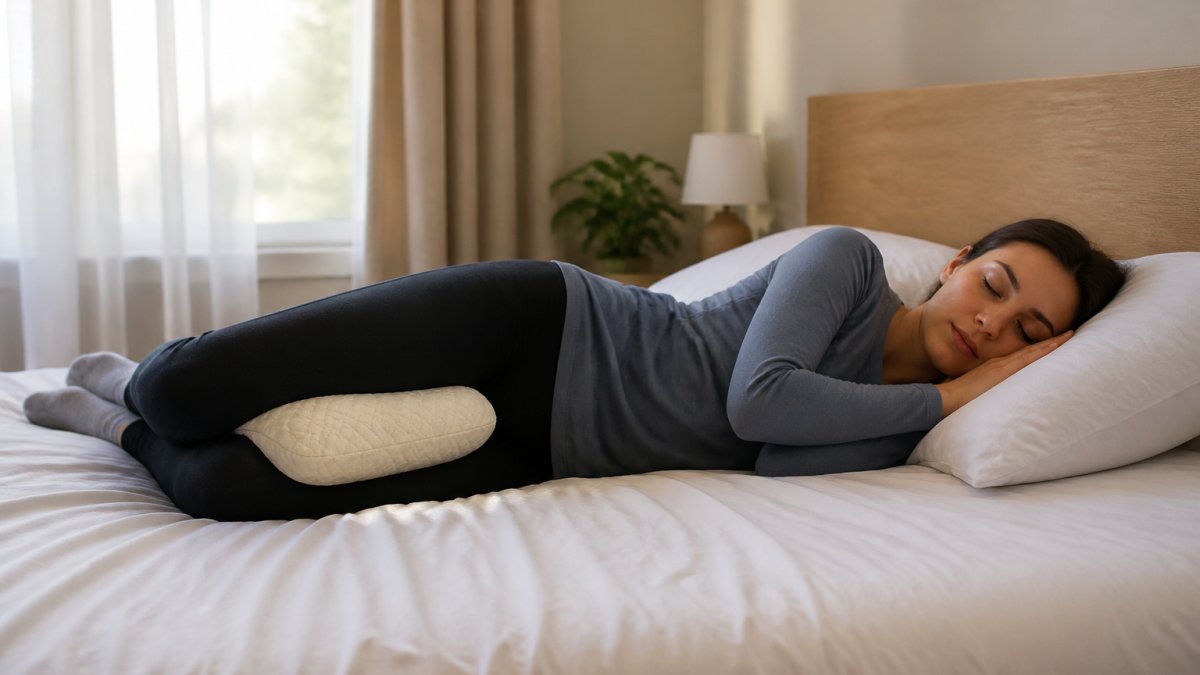
If you're a side sleeper who wants knee support that stays in place, our Kezmore CuddleNest features two curved side cushions for gentle cushioning around the body.

Pillow Under Knees for Lower Back Pain: Back Sleeping Support
A pillow under the knees is often used to ease strain on the lower back. Back sleeping with knee support is an option many people find comfortable.
Try this:
- Lie flat on your back with a pillow under your knees.
- Use a thin pillow under your head, or none.
- Keep your arms relaxed at your sides.
Watch out: sleeping flat with no knee support lets your lower back arch into the mattress. That's a common cause of morning stiffness.
Stretches for Lower Back Pain Before Bed
Gentle stretches before bed may help you feel more relaxed before settling into your chosen position. Do them slowly, and stop if anything sharpens.
- Knees to chest: lie on your back, hug both knees in, hold 20 seconds.
- Pelvic tilt: lie on your back, flatten your lower back into the mattress, hold 5 seconds, repeat 10 times.
- Cat-cow: on hands and knees, arch and round your spine slowly, 10 rounds.
Keep each stretch gentle. A physiotherapist can tailor a routine to your specific pain.
Stomach Sleeping, Position Changes and Red Flags
Most guides tell you to avoid stomach sleeping, and for good reason: it arches your lower back and twists your neck. But "just don't do it" isn't useful if it's the only way you can fall asleep. Here's how to modify it, how to change positions safely overnight, and when back pain needs a doctor rather than a pillow.
If You Can't Sleep Any Other Way: Modifying Stomach Sleeping
Stomach sleeping puts your lower spine into extension, compressing the joints at the back of the spine and aggravating pain that's worse when you arch backward. It also forces your neck to turn to one side for hours. If you can't comfortably sleep on your side or back, try these modifications:
- Put a thin pillow under your hips and lower belly. This reduces the arch in your lower back rather than deepening it.
- Skip the head pillow, or use a very thin one. A pillow under your head lifts your neck into extension, the opposite of what a stomach sleeper needs.
- Hug a pillow or place one under one side of your chest. This slightly rolls you toward your side, taking pressure off your lower back.
People who sleep on their stomach often also sleep with one knee pulled up toward the chest, which twists the lower back. If you notice yourself doing it, slide a pillow under the bent knee, or work on transitioning to side sleeping over a few weeks.
How to Change Positions Safely During the Night
Most advice focuses on the position you fall asleep in, but you'll change positions several times a night. Moving badly is a common way to wake up sore. A few rules help:
- Keep your knees bent when you turn. Bend both knees before you roll, and turn your whole body as a unit rather than twisting at the waist.
- Log-roll rather than twist. To go from your back to your side, bend your knees, drop them to one side, and let your shoulders follow. Reverse it to go back.
- Sit up before you stand. Roll to your side, push up with your arms while keeping your knees bent, and swing your legs over the edge. Avoid sitting straight up from flat on your back.
When Back Pain Needs a Doctor, Not a Pillow
Some back pain needs medical assessment. See a professional promptly if you notice:
- Pain that spreads down a leg or causes numbness or tingling
- Weakness in a leg or foot, such as difficulty lifting your foot or climbing stairs
- Pain after a fall or injury
Those signs can point to nerve problems, and they need medical assessment rather than a change in sleeping position. A physiotherapist or doctor can also tailor a sleep setup to your specific diagnosis.
A Simple Way to Tell If a Position Is Helping
Because backs vary, the only reliable test is your own pattern over several nights. Track three things for a week: how comfortable you are when you fall asleep, how many times you wake, and how your lower back feels in the first ten minutes after you get up. If morning stiffness and night waking both drop over three to four nights, the position and support are working.
Frequently Asked Questions
Which sleeping position is best for lower back pain?
Supported side sleeping and back sleeping with a pillow under the knees are the two positions most often recommended. Supported side sleeping and a pillow under the knees for back sleepers are commonly suggested approaches. There is no single position that suits everyone, so try both for a few nights and note which one leaves you waking with less stiffness.
Is it better to sleep on your back or side for lower back pain?
Both can work if you add support. Back sleeping with a pillow beneath the knees keeps the lower back closer to its natural curve, while side sleeping with a pillow between the knees keeps the hips and pelvis aligned. Many people find back sleeping comfortable, and supported side sleeping is another common option for back pain.
Should you put a pillow under your knees when sleeping with lower back pain?
Yes, for back sleeping it is one of the simplest adjustments you can make. A pillow under the knees is a simple adjustment many back sleepers use to support their lower back. Pair it with a supportive mattress and a pillow that keeps your neck neutral rather than propped up.
How can you make stomach sleeping more comfortable for your lower back?
Stomach sleeping is commonly advised against because it arches the lower back, but you can reduce the strain. Try placing a thin pillow under your hips or lower belly to soften the arch, and use a very flat pillow under your head or none at all. If you wake with lower back pain most mornings, treat stomach sleeping as the first habit to change and shift toward supported side or back sleeping instead.
